Construction sites involve the movement of materials, tools and equipment throughout the day. From transporting components within a building to moving supplies across a work area, having the right material handling equipment can make daily operations more organized.
MS and aluminium trolleys help move materials from one location to another with less manual handling. The right trolley depends on the type of material, load requirements, site conditions, movement frequency and available space.
For construction businesses looking for MS Aluminium Trolleys Pune, understanding the differences between these materials and their applications can help in choosing a suitable solution for the project.
What Are MS and Aluminium Trolleys?
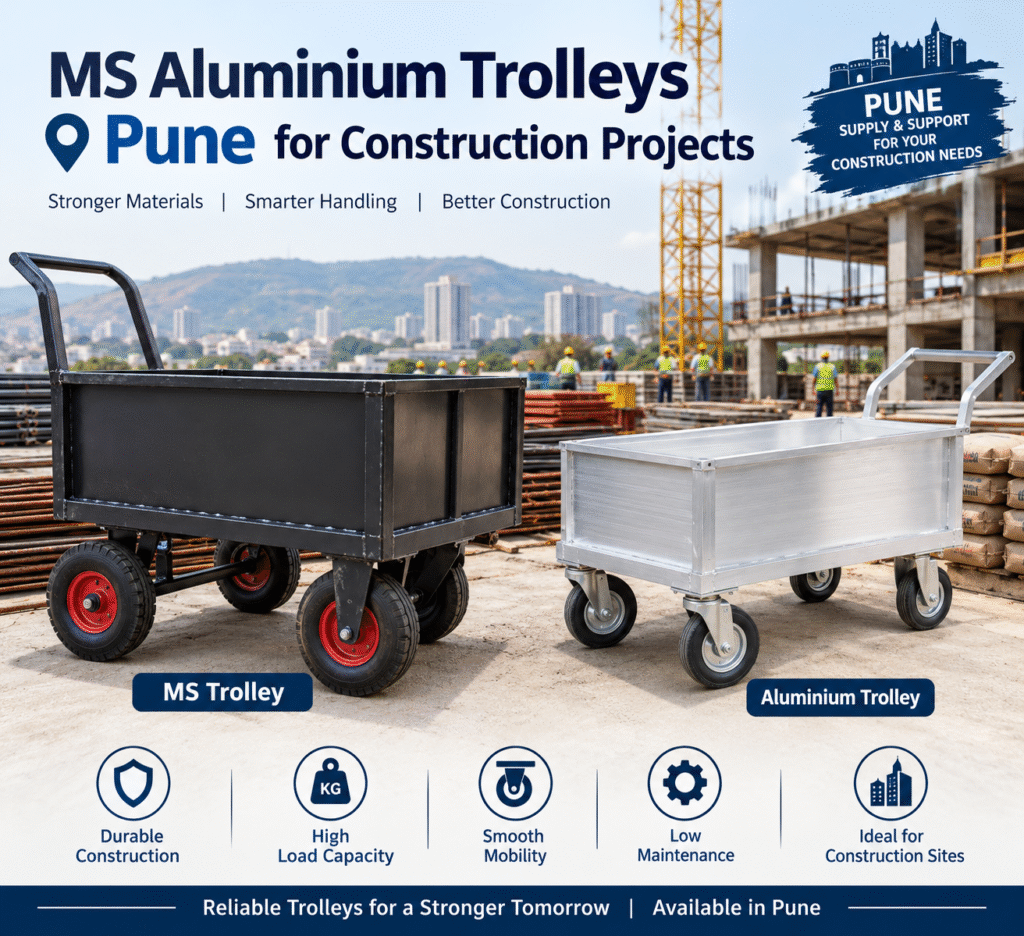
MS stands for mild steel, a material commonly used to manufacture strong and durable equipment for industrial and construction applications. Aluminium trolleys are made using aluminium, which is generally lighter than mild steel.
Both types can be designed for transporting materials, tools, components and supplies. However, their construction, load capacity and suitability vary according to the design and intended use.
- MS trolleys: Often considered for applications where strength, durability and resistance to demanding working conditions are important.
- Aluminium trolleys: Often suitable when lower equipment weight, easier handling and corrosion resistance are priorities.
The material alone does not determine a trolley’s performance. Its frame design, dimensions, wheels, joints and rated load capacity also matter.
Where Are Construction Trolleys Used?
Trolleys can support material movement across different construction and industrial environments.
1. Construction Sites
Workers may need to transport tools, fittings, construction accessories and other supplies between storage areas and work zones. A suitable trolley can help organize these movements.
2. Warehouses and Storage Areas
Trolleys can be used to move packaged materials, components and supplies between storage racks, loading areas and dispatch points.
3. Industrial Facilities
Manufacturing and industrial operations may use trolleys to transport parts, tools and equipment between workstations.
4. Maintenance Projects
During repair and maintenance activities, trolleys can help carry tools and selected materials to the required work area.
5. Scaffolding and Construction Equipment Handling
Depending on their design and load rating, suitable trolleys can support the movement of scaffolding accessories and other construction components. Special care is required when transporting long or heavy components.
MS Trolleys vs Aluminium Trolleys: Which Is Better?
There is no single option that suits every application. The right choice depends on how the trolley will be used.
| Feature | MS Trolleys | Aluminium Trolleys |
|---|---|---|
| Material | Mild steel | Aluminium |
| Equipment weight | Generally heavier | Generally lighter |
| Strength | Can support demanding loads when properly designed | Depends on alloy, design and construction |
| Corrosion resistance | Usually needs suitable surface protection | Generally offers better natural corrosion resistance |
| Handling | Heavier to move when unloaded | Often easier to move when unloaded |
| Maintenance | May require attention to paint or protective coating | Still requires inspection and appropriate maintenance |
| Best suited for | Applications prioritizing strength and durability | Applications prioritizing lower weight and corrosion resistance |
Important: Always check the manufacturer’s rated load capacity. Neither MS nor aluminium automatically makes a trolley suitable for heavy loads without considering its design and construction.
What Are the Benefits of Using Material Handling Trolleys?
Choosing a suitable trolley can support smoother material movement and better workplace organization.
Reduced Manual Carrying
A trolley can reduce the need to carry certain materials by hand, provided the load is suitable for the trolley and the route is safe.
Better Material Organization
Designated trolleys can help keep tools, components and supplies together while they are being moved around the site.
Improved Movement Between Work Areas
Wheeled equipment can make transporting suitable loads easier across compatible surfaces.
Efficient Use of Working Time
When materials can be moved in organized loads, workers may spend less time making repeated trips. Actual time savings depend on the site layout and workflow.
Flexible Applications
Different trolley designs can be selected for specific requirements, including flat-platform transport, tool storage and movement of particular components.
How to Choose the Right MS or Aluminium Trolley
Before selecting a trolley, consider the following factors.
Load Capacity
Estimate the weight of the materials that will be transported. Choose a trolley with a suitable rated capacity and avoid exceeding its limits.
Trolley Dimensions
The platform size should accommodate the materials without creating an unstable or poorly balanced load.
Wheel Type
Wheels should suit the floor surface, expected load and turning requirements. Construction sites with rough or uneven surfaces may need a different wheel arrangement from smooth warehouse floors.
Material and Finish
Consider exposure to moisture, dust, chemicals and other environmental conditions when selecting the trolley material and surface protection.
Movement and Storage
Check whether the trolley can move through doorways, corridors and access routes. Storage space and turning radius may also influence the design.
Handle and Frame Design
The handle, frame, joints and platform should be appropriate for the intended use. Ergonomic handling and stability are important for routine material movement.
Maintenance Requirements
Wheels, fasteners, handles and structural components should be inspected regularly for wear, damage or loosening.
What Affects the Cost of MS and Aluminium Trolleys in Pune?
The price of a trolley depends on its specifications rather than just the material used.
Common cost factors include:
- Mild steel or aluminium construction
- Overall dimensions
- Load capacity
- Frame and platform design
- Wheel type and quality
- Customization requirements
- Surface finishing
- Number of units required
- Manufacturing and delivery requirements
A standard trolley and a trolley designed for a specific industrial application may have significantly different costs. For an accurate quotation, provide the supplier with the intended use, approximate load, required dimensions and operating conditions.
Are Customized Trolleys Suitable for Construction Projects?
Yes. Customized trolleys can be considered when standard designs do not meet the requirements of a particular application.
For example, a project may need a specific platform size, a different handle arrangement, dedicated compartments or wheels suitable for a particular floor surface.
Before manufacturing a customized trolley, the required load, dimensions, centre of gravity, movement path and operating environment should be assessed. The finished design should be suitable for its intended application and tested or verified as appropriate.
MS Aluminium Trolleys in Pune by Creador Innovations
Creador Innovations provides scaffolding and related construction solutions for project requirements. When evaluating material handling equipment such as MS and aluminium trolleys, it is important to match the product specifications with the actual site application.
Construction companies should communicate their expected load, material dimensions, floor conditions, movement frequency and storage requirements before finalizing a trolley.
For businesses searching for MS Aluminium Trolleys Pune, a requirement-based approach can help identify equipment that fits their material handling needs.
Frequently Asked Questions
What is the difference between MS and aluminium trolleys?
MS trolleys are made from mild steel and are often chosen for strength and durability. Aluminium trolleys are generally lighter and offer good natural corrosion resistance. The best option depends on the design, load and working environment.
Which trolley is suitable for construction sites?
The suitable trolley depends on the material being transported, its weight, the surface condition and the available access routes. A trolley should always be selected according to its rated capacity and intended use.
Are aluminium trolleys lighter than MS trolleys?
Generally, yes. Aluminium is less dense than mild steel, so an aluminium trolley of comparable design may weigh less. Actual weight depends on dimensions, material thickness and construction.
What is the load capacity of a construction trolley?
Load capacity varies by design and manufacturer. Check the rated capacity of the specific trolley and do not exceed it.
Can MS and aluminium trolleys be customized?
Customization may be possible depending on the manufacturer and application. Dimensions, platform design, handle placement and wheel selection can be discussed according to the intended use.
How do I choose an MS or aluminium trolley supplier in Pune?
Compare material specifications, rated load capacity, dimensions, construction quality, wheel arrangement, customization options and delivery terms. Make sure the trolley is designed for the conditions in which it will be used.
Final Thought
MS and aluminium trolleys can be useful for moving materials across construction sites, warehouses and industrial facilities. Mild steel may be preferred for certain demanding applications, while aluminium can be advantageous when lower equipment weight and corrosion resistance are important.
For businesses searching for MS Aluminium Trolleys Pune for Construction Projects, the best choice depends on load capacity, trolley design, floor conditions, movement requirements and budget.
Evaluating these factors before purchasing can help you select a trolley that suits your daily operations and